.png)

How Do I Know If a Marketing Agency Is Actually Delivering Results?
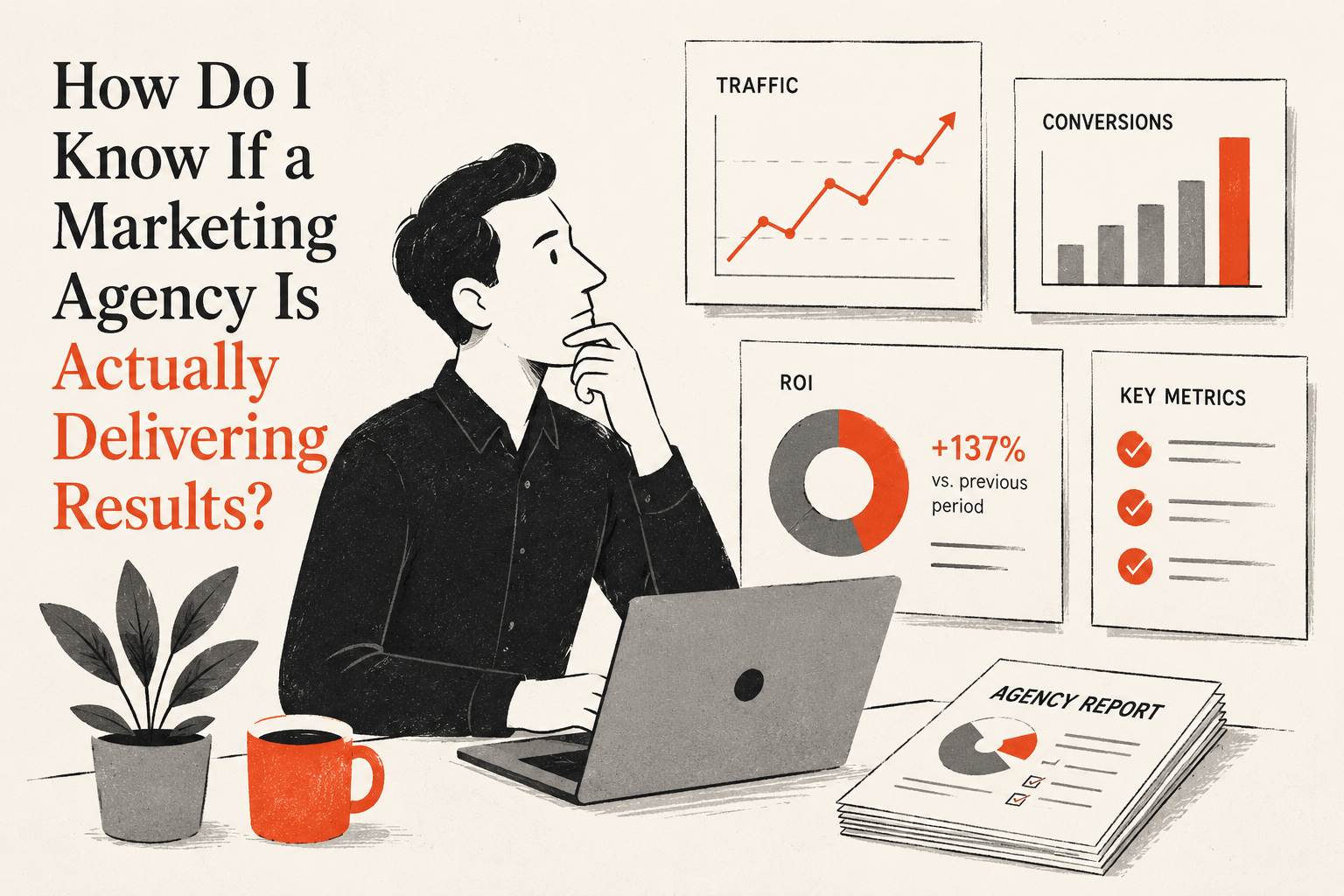
Most agencies don’t fail because they can’t generate activity.
They fail because they optimise for the wrong success indicators.
Clicks, “more leads generated”, and platform-reported conversions can all look good on the dashboards, but bottom line impact stays flat, and the same challenges are being experienced not 6 months later.
So the real question isn’t “are they getting results?” It’s: “what are the results actually tied to?”
Here’s how to tell.
1. Start with strategy → not execution
The first thing I look at is simple:
Does the campaign setup actually reflect the strategy they proposed?
A good agency doesn’t just “run ads” or “do SEO”.
They build systems that reflect intent:
- Are campaigns structured around buyer stages?
- Is messaging aligned to buyer intent, not generic keywords?
- Is there a path to conversion?
- What’s the next step?
Setup can look “standard” across accounts, that’s fine. That’s to be expected.
What matters is whether it’s being actively managed in line with a real strategy.
The other side to this is to ensure your agency doesn’t stray off course from the original strategy.
Which leads to the second signal:
Are they proactively optimising, or just maintaining?
You want to see:
- Regular iteration
- Clear reasoning behind changes
- Proactive recommendations (not just responses to client asks)
If it feels like “set and forget”, you already have your answer.
2. Vanity metrics are the biggest early warning sign
This is where most agencies quietly drift away from real performance.
If reporting is heavy on:
- Impressions
- Clicks
- Traffic
- “Leads generated” without context
…but light on revenue impact, you’re looking at a reporting problem disguised as a performance report.
A strong agency will always tie activity back to:
- Pipeline
- Revenue
- Qualified leads
- Sales efficiency
If they can’t connect those dots, they’re not measuring success. They’re measuring activity.
3. Conversion tracking mistakes are more common than you think
One of the fastest red flags I see:
irrelevant or inflated conversion actions in Google Ads or other platforms
Examples:
- Tracking form starts as conversions
- Tracking low-intent page views as “leads”
- Multiple duplicate conversion actions inflating performance
- No distinction between qualified vs unqualified leads
These are usually not malicious — they’re just lazy setup.
But the impact is the same:
It creates the illusion of performance where none exists.
4. Good performance is always multi-channel and revenue-tied
If an agency is only optimising one channel in isolation, you’re missing the real picture.
Strong performance typically looks like:
- Multi-channel influence (search + LinkedIn + remarketing + organic)
- Full-funnel alignment
- Clear connection to pipeline and revenue outcomes
Not everything will convert directly.
But everything should contribute to a system that does.
5. The only metrics that really matter
This changes slightly per client, but the core stays consistent.
The metrics I trust most are:
- Pipeline value generated
- Self-reported attribution (what actually drove the deal)
- Qualified leads (not just leads)
- Pipeline efficiency (cost vs value generated)
- Conversion rate from lead → opportunity → deal
Everything else is secondary.
If an agency can’t translate activity into one of those buckets, they’re not operating at a business level — they’re operating at a platform level.
6. Quality beats quantity — every time
This is where most conversations go wrong.
Clients often start with:
“We need more leads”
But the real question is:
“What quality of leads actually moves revenue?”
Here’s the simple framing:
If you generate:
- 10 leads/week → 25% close rate = 2.5 customers
That’s often worse than:
- 12 leads/week → 50% close rate = 6 customers
Slightly more volume, massively better targeting = exponential impact.
If your agency isn’t leading with quality first, they’re optimising for volume — not outcomes.
7. Reporting can hide more than it reveals
Two major red flags:
- Over-reporting (too many dashboards, too many metrics)
- Under-explaining (no narrative, just numbers)
Good reporting should do one thing:
Explain what changed, why it changed, and what’s next.
If reports feel like data dumps, the agency is either:
- Not thinking strategically, or
- Avoiding accountability
8. Time lag is often used to deflect accountability
Especially in SEO, brand campaigns, or longer B2B sales cycles.
A legitimate lag exists — but it shouldn’t become a shield.
Watch for:
- Constant pushing of reporting windows
- “It needs more time” without directional improvement
- No leading indicators of progress
Even long-term channels should show early signals:
- Better engagement quality
- Improved rankings in meaningful terms
- Lower cost per qualified action
- Improved conversion rates
If nothing is improving at any stage, time isn’t the issue — direction is.
9. Attribution confusion is where most misunderstandings happen
A lot of businesses get misled by one idea:
“We can’t see the full picture, so we assume what the platform shows is correct.”
It’s not.
Last-click attribution will:
- Over-credit lower-funnel channels
- Under-credit awareness and influence channels
- Miss multi-touch journeys entirely
A good agency will challenge attribution models, not blindly report them.
10. The simplest way to evaluate any agency
Strip everything back.
Ask these questions:
- How often do they proactively check in with recommendations?
- Are they interested in your bottom-line outcomes or just scoped tasks?
- Do they challenge your assumptions or just execute requests?
- Can they clearly connect activity → pipeline → revenue?
- Do they talk about quality of leads, not just quantity?
If the answer is mostly “no” or “unclear”, you already know what that means.
Final thought
A marketing agency is not a “channel operator”.
It should be a revenue system designer.
If their reporting doesn’t reflect that, their strategy probably doesn’t either.
That’s the real difference between “marketing activity” and actual performance.

Over the years during my time in digital and agency roles I've accrued technical experience across digital which have lead me to excel in my role today as a Digital Strategist. My approach focuses on combining digital tactics and techniques to drive big picture growth for businesses.
My goal with Knightlab is to work with marketing teams and businesses to maximise their existing digital stack and capabilities. Along the way, I hope to change how my clients approach and view digital and marketing, so that it's better suited to long-term success.


10+
years experience
100+
of Campaigns launched and managed
$6b+
project value experience
Do Digital Differently
Because the same old approach will get you the same old outcomes. Change your approach and change your results.
Digital + Marketing
Knightlab takes a marketing-principles first approach rather than an over reliance on digital platforms. Algorithms change, marketing fundamentals do not.
Long-term focus
We prioritise long-term success over short-term wins. Because this reflects the reality of digital marketing effectiveness.